Banks - All › Banks
Online Bank vs. Branch Bank: Who Should Choose Which in 2026
Here is the whole argument in one deposit. Keep $10,000 in a standard savings account at one of the giant branch banks and, at the 0.01 percent APY those banks still post on basic savings, you will earn about a dollar this year. Move the same $10,000 to a top online savings account and you will earn roughly $420 to $450. Same federal insurance. Same right to withdraw your money. The difference is not risk, cleverness, or fine print. It is rent: one bank pays for thousands of branches and tellers, and the other does not, and in 2026 that cost difference lands almost entirely in your interest rate.
And yet the branch banks are not empty, and they are not empty because their customers cannot do arithmetic. The Consumer Financial Protection Bureau's National Age-Friendly Banking Survey found that 45 percent of account holders had used a branch in the previous 30 days — 58 percent among people over 60 — and a majority said having a branch available was very important to them. People are buying something with that forgone interest. The honest question for 2026 is not which bank is "better." It is what, exactly, each model gives you, what it quietly takes, and which of those things your actual life requires.
The rate gap, in dollars
Start with the benchmarks, because banks count on you not knowing them. The FDIC's national average rate for savings accounts was 0.41 percent in its January 2025 release, and it was still hovering just under 0.40 percent in late 2026. That average is itself misleading: it blends thousands of small institutions paying something reasonable with the biggest branch networks paying almost nothing. RateZip, which captures posted rates daily, put the average standard savings rate at Chase, Bank of America, and Wells Fargo at 0.02 percent on November 24, 2026, against a top tracked online rate of 4.50 percent — a gap of 448 basis points that, by its tracking, had not closed on a single day since it began measuring in July 2026.
Translated into money on a static balance, before tax:
| Where the $10,000 sits | Posted APY | Interest in one year |
|---|---|---|
| Big branch bank, standard savings | 0.01%–0.02% | $1–$2 |
| FDIC national average savings account | ~0.39% | ~$39 |
| Top online high-yield savings | 4.20%–4.50% | $420–$450 |
Two honest caveats. First, online rates are variable and move with the Federal Reserve's benchmark; when the Fed cuts, online APYs fall within weeks, while branch-bank rates — already at the floor — barely move at all. The gap narrows in a falling-rate world; it has not come close to disappearing. Second, the very top online rates sometimes carry conditions — a balance cap, a direct-deposit requirement, an introductory window. The 4.20 percent tier in late 2026 was available with no strings attached at more than one online bank, so treat any rate above that as a promotion to be read carefully, not as the market.
Checking shows the same pattern in miniature. Most branch-bank checking pays nothing at all; the FDIC's average for interest checking has sat around 0.07 percent. Online checking commonly pays a small but real rate, and a handful of high-yield checking accounts pay considerably more in exchange for debit-card use and direct deposit. On a working balance of a few thousand dollars this is tens of dollars a year, not hundreds — worth having, not worth choosing a bank over by itself.

Fees: the second, quieter gap
Interest is the visible difference. Fees are where branch banking's cost shows up month by month. Published 2026 fee schedules put basic checking at the large branch banks at $12 to $15 a month — Chase Total Checking at $15, Bank of America's Advantage Plus at $12, Wells Fargo's Everyday Checking at $15 — each waivable if you meet a condition: typically $250 to $500 in monthly direct deposits, or a $1,500 minimum daily balance. Meet the condition every month and the fee is theoretical. Miss it in one lean month and you have paid $15 for the privilege of holding your own money.
The standard online checking account, by contrast, charges no monthly maintenance fee and requires no minimum balance — not as a promotion, but as the product. Overdrafts follow the same split. Several online banks and fintech apps have eliminated overdraft fees entirely, and some branch giants have cut theirs — Bank of America now charges $10 — but Chase still charges $34 and Wells Fargo $35 per covered overdraft, with grace features that soften rather than remove the charge. Out-of-network ATM fees cut the other way less than people expect: online banks typically give you a large partner network — Ally advertises more than 75,000 fee-free ATMs through the Allpoint and MoneyPass networks, plus a small monthly reimbursement for out-of-network use — while a branch bank's own network is bigger in its home regions and useless outside them.
The fair summary: a disciplined customer who always meets the waiver conditions can bank at a branch bank almost free. An undisciplined or simply irregular one — freelance income, seasonal work, a thin month — will pay branch fees that an online bank would never have charged.
What a branch actually buys you
If branches were pure overhead, they would already be gone. The FDIC counted 69,167 bank branches in the United States at the end of 2025, down from a peak above 99,000 in 2008–2009 — a long consolidation, but one that still leaves a branch within reach of most Americans. Here is what walking into one buys:
Cash deposits. This is the decisive one. An online bank can take your money by direct deposit, mobile check capture, wire, and transfer — but physical cash has no clean way in. Some online banks let you deposit cash at retail registers or partner ATMs, usually for a fee and with limits. If you are paid in cash, tip out in cash, or run a cash-heavy small business, a branch (or a local credit union) is not a preference; it is infrastructure.
A human for the bad days. Fraud holds, estate paperwork after a death, a wire that went wrong, a cashier's check needed this afternoon, a notary, a safe-deposit box: these are branch tasks. They are rare, and they cluster at the worst moments of a financial life. Gallup's retail banking research has long found that customers prefer a branch precisely for high-stakes interactions — opening and closing accounts, applying for loans, reporting problems — while preferring digital channels for routine ones.
Local knowledge and local credit. A community or regional branch bank makes lending decisions with local context an algorithm does not have. For a straightforward mortgage or auto loan this rarely matters; for a small-business loan with an irregular story, it can matter a great deal.
What a branch does not buy you in 2026 is a better app, longer service hours, or faster routine banking. On those, the online banks — whose entire product is the app — are usually ahead, and the branch banks' own apps are mostly good enough that the difference no longer decides anything.
Safety is not the difference — with one label to check
An online bank that is a chartered, FDIC-insured bank protects your deposits exactly as a branch bank does: $250,000 per depositor, per institution, per ownership category. Ally, Capital One, Marcus, SoFi Bank, and their peers are banks in the legal sense, whatever their storefront count. Your money is not safer in a building with columns.
The label to check is the newer one: the app that is not a bank at all. Chime, to take the largest example, states plainly that it is a financial technology company, not a bank; its accounts are provided through partner banks, and your deposit insurance runs through that partnership. Done properly, the insurance is real. But the structure adds a middleman between you and the insured institution, and the collapse of a middleware provider in 2024 left some fintech customers locked out of their funds for weeks while records were untangled — the money was insured against bank failure, not against bookkeeping chaos. The rule is simple: whatever app you use, find the name of the actual FDIC-insured bank behind it, and confirm that bank in the FDIC's BankFind directory before you move serious money.
Who should choose which
Choose an online bank as your main bank if your pay arrives by direct deposit, you rarely touch cash, you keep a meaningful savings balance that is currently earning 0.01 percent, and you are comfortable resolving problems by chat and phone. For a salaried renter with a $15,000 emergency fund, the switch is worth roughly $600 a year in interest and fees. There is no counter-argument of substance.
Choose a branch bank as your main bank if you deposit cash more than once or twice a month; you are settling an estate, running a cash business, or expect complicated borrowing; you manage money jointly with someone who will not use an app; or you know, honestly, that you resolve financial stress by talking to a person. Pay for the branch knowingly: keep savings elsewhere so the branch's 0.01 percent is not taxing your whole balance.
Choose both — which is what most switchers actually do. Keep a checking account at a branch bank or credit union near you, holding a working balance and handling cash, checks, and paperwork. Keep savings at an online bank, linked for transfers, where it earns the market rate. Transfers between the two take one to three business days, which is the entire cost of the arrangement, plus one more login to remember. The CFPB's survey suggests Americans are already most of the way there: three-quarters used mobile banking in the previous month while nearly half also used a branch.
Vetting either kind before you move
Whichever model you pick, do the unglamorous checks. Confirm FDIC or NCUA insurance in the regulator's own directory, not from the bank's marketing page. Read the fee schedule PDF for the specific account — monthly fee, waiver condition, overdraft practice, wire and cashier's-check charges. For an online bank, check the transfer limits and hold policy: a great APY is no comfort if a $20,000 inbound transfer is capped or held for a week. And use a directory as a map rather than a verdict: this site's listings alone include 7,521 locations tagged for ATMs and 2,632 listed as banks, which is a reminder that "access" is a local question — count the machines and branches you would actually use, near the places you actually go.
The branch is not dead and the online bank is not a fad; they are two different products that happen to share a name. Buy the one that matches the way money actually moves through your life — and if that answer is "both," you are in the growing majority, and about $400 a year better off than the customer who never asked the question.
Sources
- FDIC, National Rates and Rate Caps, January 2025 — national average savings rate of 0.41%. https://fdic.gov/national-rates-and-rate-caps/monthly-update-january-2025
- FDIC, BankFind Suite, Annual Data Summaries — 69,167 U.S. bank branches in 2025; institution and branch counts by year. https://banks.data.fdic.gov/bankfind-suite/historical
- Consumer Financial Protection Bureau, National Age-Friendly Banking Survey, Technical Report (March 2026) — channel use in the previous 30 days (mobile 76%, ATM 61%, online 55%, branch 45% overall; branch 58% among adults 60+) and the importance respondents place on having a branch. https://files.consumerfinance.gov/f/documents/cfpb_nafbs-puf-technical-report_2026-03.pdf
- RateZip, The Savings Gap (data captured November 24, 2026) — Chase, Bank of America, and Wells Fargo averaging 0.02% APY on standard savings against a top tracked online rate of 4.50%. https://www.ratezip.com/data/savings-gap
- WealthVieu, Bank Fees Guide 2026 — monthly maintenance fees, waiver conditions, and overdraft fees at major branch and online banks, checked September 2026. https://wealthvieu.com/banking/fees/
- Photo by Karolina Grabowska, https://www.pexels.com/photo/crop-man-counting-dollar-banknotes-4386431/
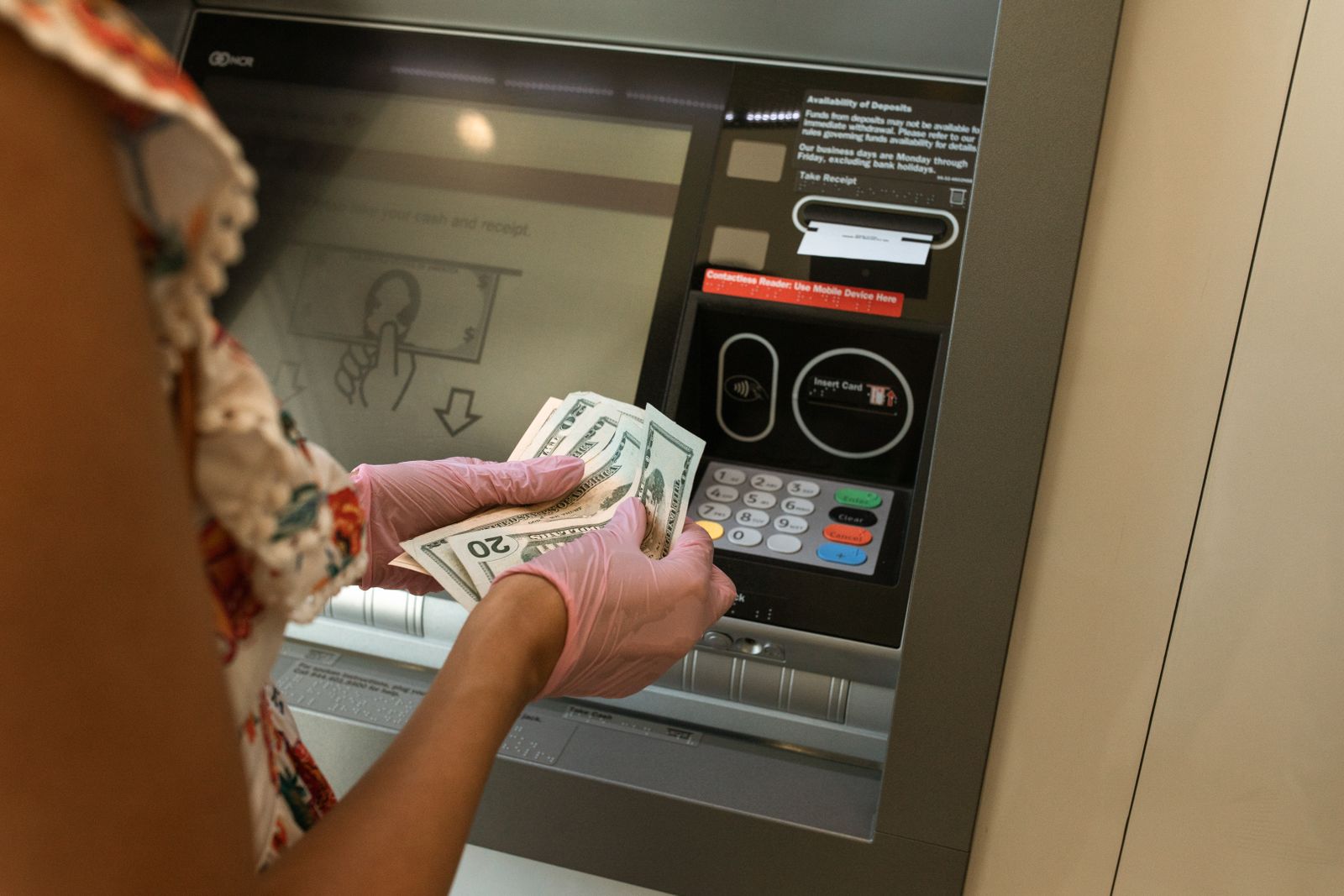
- Photo by RDNE Stock project, https://www.pexels.com/photo/person-counting-money-in-front-of-atm-5699376/